The Soapbox: Soccer Coaching Blog & Podcast
Heads and Volleys is a grassroots Soccer game that reflects the youth soccer environment.
The game was played as everyone VS the GK and you could only score with a header or a volley. Simple, right? Wrong. It was complex and fraught with arguments that resulted in 'taking my ball home' or some kind of one-off shot to determine if it was a goal or not. Much like those arguments, this podcast will embrace discussions, trends, and ideas to grow the game, and will not let anyone take their ball home early.
Heads and Volleys Podcast.

Welcome to my soapbox. This is where I think out loud about coaching.

You'll find long-form writing on coaching methodology, session design, game models and player development — plus every episode of the Heads and Volleys podcast. It's written for youth and club soccer coaches, directors of coaching, and anyone building a curriculum they want their whole staff to speak.
Most of what's here comes back to a few ideas: that soccer is 1v1s with help, that a Common Language across your club beats a clever drill, that the rule you add is the game you get, and that you can't coach what you haven't defined.

New posts most weeks. Start anywhere below, or grab the monthly newsletter.
Popular Reads
The Common Language
- The Power of a Common Language
- The Common Language Methodology: The Game is Already in Your Practice
The 1v1 Series
Session & Practice Design
- Can You Recreate the Game in Practice?
- The Rule You Add Is the Game You Get
- From 1,000 Touches to 1,000 Decisions
- Optimize Your Training Environment
- The First Pancake Is Always Awful
Game Day
Player Development
The Reason Your Sessions Lack Intensity? Look at the Coach.
"Intensity doesn't come from telling players to try harder. It comes from how you organize the session. Most coaches are draining it before a ball is kicked."
Coaches ask me this all the time: how do I get more intensity from my players?
And my answer, which isn't always what they want to hear, is this: stop looking at your players. Look at how you're organizing the session.
Because intensity isn't something players bring with them. It isn't a character trait. It's not something you can demand, shout for, or punish your way into. Intensity is the output of a well-organized environment. And if it isn't there, nine times out of ten, the organization is the problem.
The First Thing That Kills It: Dead Time
Walk onto any training field and watch the gaps. Not the activities — the transitions between them.
Players stand while you explain the next drill. Then they stand while you adjust the cones. Then you explain again because the first explanation wasn't clear. Then someone asks a question, you answer it, and by the time the game starts, four minutes have disappeared and the group has completely switched off.
Dead time is the single biggest intensity killer in youth coaching. And it's entirely within the coach's control.
The fix is simple but requires preparation: know exactly what you're setting up next before the current activity ends. Have the cones down, the pinnies sorted, the teams decided. The transition should take thirty seconds, not four minutes. Players who go straight from one competitive activity into another never get the chance to disengage. That's where you want them — always on the edge of the next thing.
Team Balance: The Hidden Intensity Dial
Here's something coaches underestimate: the intensity of a session rises and falls almost entirely on whether the teams are balanced.
Imbalanced teams are devastating for intensity. One side wins every rep. The losing side stops caring — not because they're lazy, but because there's no real competition anymore. The contest is over before it started. And once a player stops believing they can win, you've lost them for the rest of the activity.
Balancing teams is an organizational act. It requires you to watch, adjust, and sometimes make uncomfortable decisions — moving the stronger player, giving the weaker team an extra player, adjusting the rules to level the contest. That's coaching. That's organization. And when you get it right, you'll see the intensity shift almost immediately, because now both sides believe they're in a game they can win.
How Long Is Too Long?
Every activity has a window. At some point, the quality starts to drop — a tackle becomes a shove, someone laughs when the ball goes out instead of sprinting after it, the decision-making slows down. That's the signal. The intensity has peaked and is now falling.
Most coaches run activities too long. They keep going past the window because the activity is working, or because they haven't decided what comes next, or because they're in the middle of a conversation. And five minutes past the intensity peak, you're not developing anyone. You're just filling time.
The organizational discipline here is to end it earlier than feels natural. Stop while it's still good. The players should walk away from each activity wanting another rep, not relieved it's over. That appetite carries into the next activity and keeps the temperature of the session high throughout.
Clarity of Rules: You Can't Be Intense About Something You Don't Understand
I've watched sessions where the coach spends eight minutes explaining the rules of a game that should take thirty seconds to explain. Players glaze over. By the time the ball is rolling, nobody is sure what they're supposed to be doing — so nobody really commits.
You cannot be intense about something you don't understand. Intensity requires clarity: I know what I'm trying to do, I know what I'm trying to stop, I know what winning looks like. If any of those things are unclear, players default to going through the motions.
Keep your explanations short. Start the game quickly. Let them figure it out while playing — not while standing still listening to you. If something isn't working, pause briefly, fix it, restart. But get the ball moving as fast as possible.
Stakes and Consequences: The Intensity Switch
The final organizational tool — and maybe the most important — is having a clear answer to the question: what happens when you win?
Not a big reward. Not a speech. Just something. The winning team picks the pinnies. The losing team sets up for the next game. Winners start with the ball. Losers go in the middle. Something that makes the result matter, even slightly.
Without this, you're asking players to compete in a vacuum. And while some will bring their own internal motivation, most need an external reason to care in the moment. The organizational choice to identify winners, celebrate them briefly, and acknowledge losers with a consequence — however small — is the switch that turns a game into a contest.
Intensity follows competition. Competition follows stakes. Stakes are something you organize. It's in your hands.
The Real Question Before Every Session
Before you walk onto the field, ask yourself: have I organized this session so that intensity has somewhere to live?
Do I have clear transitions? Balanced teams? Activities with defined endpoints? Simple rules that take seconds to explain? A consequence that makes the result matter?
If the answer is yes, intensity will likely appear on its own. If the answer is no — if you're winging the transitions, eyeballing the teams, running activities until the wheels fall off — don't be surprised when the players look flat.
It's not them. It's the organization. And that part is entirely yours.
Listen to the full episode: Ep. 83 — You Control the Intensity
@LeeDunneSoccer
1v1s 7/7: Five Things I Want You to Walk Away With
"You can have all the sessions in the world. But if your players don't feel safe, they'll never truly play."
We've covered a lot of ground in this series.
Game models. Positional profiles. The why behind mastery. Constraints and their unintended consequences. Isolated 1v1's and why they matter. Small-sided games and what they do that isolated training can't. If you've been reading along, my hope is that something has shifted in how you're thinking about your training environment and your players.
But I want to close with the five things that sit underneath all of it. The foundational pieces that make everything else work — or not.
1. Your game model is the anchor.
Everything connects to it. Every 1v1 you train should reflect the situations your players face within your model. Every small-sided game should mirror the relationships and moments your model demands. Without a clear model, your training is a collection of disconnected activities. With it, every session builds on the last.
You don't need a complex system. You need a clear one. Define how you want to play, put it in writing, share it with your players, and let it drive every decision.
2. Positional profiles make the model personal.
A game model tells the team how to play. A positional profile tells the individual what their role is inside that model. When your #4 has a profile — here's what I expect from you in possession, out of possession, in transition — they have something to work toward between sessions. Something to measure themselves against. Something to talk to you about.
Give your players profiles. Make them collaboratively if you can. A player who helped build their own profile is ten times more invested in living up to it.
3. Mastery takes time, but the path is the why.
Don't just teach your players what to do. Teach them why it matters. Connect the movement to the moment. Connect the training to the game. Players who understand the why don't freeze when conditions change — they adapt. They problem-solve. They keep playing.
And invest in film. Not as punishment but as a mirror. Most young players have never watched themselves play. Watching changes everything about how they process feedback.
4. Players have to feel safe to truly play.
This is the one I care most deeply about. All the game model in the world means nothing if the environment isn't safe enough for players to express themselves. Safe to fail. Safe to try the thing that might not work. Safe to make a mistake without it being the end of the world.
The "man up" culture doesn't build players. It builds players who play not to be criticized, which is not the same thing as playing to win. Get to know your players individually — what drives them, what they're afraid of, what makes them come alive. Build an environment where all of that is welcome.
When players feel safe, they play. When they play, they grow. That's the order.
5. The 1v1 is everywhere — train it everywhere.
From isolated 1v1's to small-sided games to your approach to analyzing your own games, the 1v1 is always present. Understanding how to see it, name it, and develop it in your players changes how you watch, how you plan, and how you coach.
Start small. Watch a half with purpose and count the 1v1's. Build one session around addressing the pattern you find. Run it. Reflect on it. Adjust. Build the next one.
That's the process. That's all it is.
The game is already teaching your players. Your job is to build an environment where they can receive what the game is trying to give them — and connect it to something that makes them better.
Enjoy the process, coach.
@LeeDunneSoccer
1v1s 6/7: Take the 1v1 Outside the Box
"A 3v3 has every type of 1v1 in it. So does a 4v4. So does a 5v5. The game is already there."
I called this book 1v1's Outside the Box for a reason.
The box is the isolated 1v1. Blue player. Red player. Go. And as we talked about last post, that has real value — especially for touch repetitions, individual skill development, and building confidence in 1-on-1 situations. But it has limits too.
Because soccer isn't actually played in a box with one opponent. It's played with teammates. With movement off the ball. With second and third players making runs, providing cover, finding pockets of space. And the decisions a player makes in a real 1v1 are influenced by all of that context — by whether there's support on the left, by whether the pressure from behind means they need to lay it off rather than turn, by whether their winger has stayed wide or drifted central.
You can't replicate any of that in an isolated 1v1. But you can replicate all of it in a small-sided game.
Here's something that changed the way I think about this. Research by Critchell and colleagues looked at touch counts in small-sided games over a 10-minute period. In a 3v3, players averaged 79-100 touches. In a 5v5, it was 37-65. Compare that to 11v11, where players average 2-10 touches in a game. The more you expand the numbers, the fewer touches each individual player gets. And the more you condense it, the more each player is in the game — constantly in situations, constantly making decisions.
A 3v3 is intense. It's physically demanding. And it has every type of 1v1 in it. Face-up pressure, pressure from behind, pressure from the side, the low block — it's all there, in context, with teammates and opponents moving around it. Every second, the 1v1 landscape is shifting.
That's the game. That's what we're preparing them for.
So how do I use small-sided games in practice?
I build them around the same game model framework as the isolated work. If the focus of the week is breaking pressure from behind — your #9 and #10 dealing with tight central pressing — I set up a 3v3 that forces those positions into that exact situation. The red team is coached to replicate the type of pressure I want to work against. The scoring is set up to reward the right behavior: get the ball forward, connect with the target, break the line.
The key difference from an isolated 1v1 is that now the supporting players have skin in the game too. Your #8 isn't just watching. They're in it. They're learning why supporting the #9 matters — because they've just seen three times in a row what happens when there's no angle to play off. That understanding builds faster in a live game than from any coaching point you could deliver.
Here's a line that stuck with me from the research: "When I have the ball, my teammates are helping me with the current 1v1 situation I find myself in. When my teammate has the ball, I am working to help them."
That symbiosis — everyone working together on every 1v1 simultaneously — is the game. And small-sided games train it naturally.
A few things I pay attention to when setting up SSGs:
Match the formation to your model. If you play out of the back with a high fullback, your 4v4 should include those positional relationships. Positions by number. Players in their actual roles.
Set up the defending team with a purpose. Coach the opposition to play in a way that creates the specific problems you want your team to solve. They're not just "the other team" — they're the obstacle your game model needs to overcome.
Use goal types to shape behavior. End zones reward line-breaking and through balls. Target players reward direct play and combination work. Wide goals encourage switching and width. Real goals add realism and excitement. Each one changes how players attack and defend.
Let the game run. One of the biggest things I've learned is to intervene less and observe more. Set the environment up well, then watch what happens. When the moment is right, coach an individual in the flow rather than stopping the whole group. The game is the teacher. Let it teach.
Take the 1v1 outside the box. Put it in a small-sided game. Give it context. Give it teammates. Give it consequences.
Watch your players start to look like a team.
@LeeDunneSoccer
1v1s 5/7: Put Them 1v1 and Watch What You Learn
"Before you decide what to train, go watch a half. Count the 1v1's. What you find might surprise you."
Here's a challenge for you. Before your next practice session, watch half a game — yours, a college game, a professional match — and count the 1v1's. Not just the obvious ones where a winger takes on a fullback. All of them. Count the striker fighting for position with the center back. Count the midfielder trying to receive the ball with someone on their shoulder. Count the fullback dealing with a forward pressing from behind.
Give yourself a table. Mark face-up pressure. Side pressure. Pressure from behind. Count how many times each one happens. Note the trends.
I promise you the number is going to be higher than you expected. And once you see it, you can't unsee it.
That's the point of training 1v1's with purpose — not as a warm-up activity, but as a core coaching tool. Because those moments are happening constantly, and how your players handle them determines the outcome of your games more than almost anything else.
There are three main types of pressure I build my 1v1 training around:
Face-up pressure — the defender is in front of you, closing down. This is your winger taking on a fullback, your striker winning a ball that's been played to their feet. The key here is the first touch to create space and the ability to beat a player off the dribble or play forward quickly before the pressure arrives.
Pressure from behind — a player checking in to receive the ball with someone on their back. Your #10 dropping into space. Your #9 holding up play. This is one of the most common and most undertrained situations in youth soccer. Learning to feel the pressure, create separation, and receive on the half-turn changes everything for that player.
Pressure from the side — a player receiving as a defender steps across to press. Common all over the field. Your fullback getting the ball with a winger pressing across, your #8 receiving in a tight channel. The key is anticipating which shoulder the pressure is coming from and using the other side to either turn or play.
For each of these, I build activities around five elements: organization (who's playing, what's the setup, what are the constraints?), game-like quality (does this replicate what actually happens?), repetition (how often does each player get reps?), challenge (is the defender making it genuinely difficult?), and coaching (what specifically are you looking for and when do you intervene?).
The reset time matters more than most coaches realize. In my sessions, after any ball out or goal, the next ball is in play within six seconds. That restart speed is intentional. In a game, the next moment arrives fast. You don't get to jog back and set up a neat line. Practice should feel the same way.
One thing I want to address: the defender needs a job too. If the only goal in a 1v1 is for the attacker to beat the defender, the defender has no real incentive beyond trying hard. Give them a transition target — win the ball, play it to a target, score in a small goal. Now they're competing, not just defending. The quality of your 1v1 training goes up immediately when both players have something to play for.
And then there's what I call Transition 2 — the moment after. The 1v1 ends. What happens next? In my sessions, I build the expansion in from the start. Win the ball, play it to a supporting player, now it's a 2v1 the other way. That next moment — learning to be immediately ready after winning or losing — is part of the 1v1 too.
Watch your players in isolated 1v1's and you'll learn more about them as individuals than in almost any other environment. Who gets stuck under pressure? Who needs a second touch before they can go? Who instinctively creates space before the ball arrives? That information shapes how you coach them individually and what you build for them in your sessions.
Put them 1v1. Watch what happens. Then coach to what you see.
@LeeDunneSoccer
1v1s 4/7: The Game You Set Up Is the Game You Get
"Every constraint you add to a practice has consequences. Most coaches never think about what those consequences are."
Picture your last training session. What did you set up? A 4v4, maybe. A rondo. Some 1v1's. A possession game with a touch limit.
Now ask yourself this: how were goals scored? What did players do when they didn't have the ball? What behaviors did the activity actually produce — not what you wanted it to produce, but what actually happened?
Because here's the thing that took me a while to fully grasp: the game you set up is the game you get. The constraints you add to a practice don't just change the drill — they change the behaviors. And sometimes the behaviors they produce are the exact opposite of what you were trying to coach.
There's research to back this up. A study by Humberto Almeida looked at what happens when you add a two-touch limit to a small-sided game. The result? Players can't dribble effectively anymore. The constraint removed the condition that dribbling needs to thrive. So if you're working on breaking pressure with 1v1 ball manipulation and you're also playing two-touch — you've accidentally made the session anti-1v1. Makes sense when you think about it. But in the middle of practice, most of us aren't thinking about it.
Same thing happens with pass counts. If the rule says players must complete five passes before scoring, and one of your players wins the ball in a transition moment with a clear look at goal — what do you want them to do? Play the four more passes the rule demands? Or finish? The behavior the rule creates can conflict directly with the behavior your game model wants.
I'm not saying don't use constraints. I use them all the time. Time limits, movement demands, touch adjustments, goal formats — they're powerful tools. But they need to be chosen with intention, with an understanding of the unintended consequences.
A four-goal game produces more turns. Time limits add urgency and connect to counter-pressing. End zones reward through balls and line-breaking runs. Wide target goals encourage width and switching. Each one shapes behavior. You just have to know what behavior you're after.
A few principles I come back to when designing a session:
Start from your game model. What moment are you trying to replicate or develop? Build backward from there. If you want your fullbacks to win 1v1's against wide forwards who press from the side, set up an activity that creates exactly that situation — repeatedly.
Observe what's actually happening. Halfway through a session, step back and watch. Is the activity producing the behaviors you planned for? If not, adjust. Change a goal size. Widen the space. Shift the constraint. You're not married to the plan.
Use "coach the opposition" as a tool. One of my favorites. Instead of giving both teams the same instructions, set up the defending team to play a specific style — high press, low block, man-marking — to give the attacking team a real, specific problem to solve. You can replicate next week's opponent in training. You can build familiarity before Saturday.
Randomize sometimes. If your players always face the same constraint, they develop a solution specific to that constraint. Rotate your constraint types. Keep them adapting.
And always have a backup plan. Sessions look different live than they do in your head. Know what you're going to adjust if the activity isn't working. That flexibility — that ability to read what's happening and respond — is what separates a good training environment from a great one.
The more time you invest in planning, the more time you get to spend actually coaching. Because when the environment is right, the game teaches itself.
@LeeDunneSoccer
1v1s 3/7: Mastery Comes From Asking Why
"If your player only ever does what you tell them, what happens when you're not there?"
I want to tell you about two types of players I've coached.
The first type can execute perfectly in training. Show them a movement pattern and they'll nail it. Run the rondo and they're sharp. But put them in a game, moment changes, opponent shifts, and they freeze. They look to the sideline. They wait for an instruction. They've learned how to do things, but they don't understand why.
The second type makes mistakes. A lot, at first. They lose the ball. They try something ambitious and it doesn't come off. But when you ask them afterwards why they made that decision — they can tell you. They saw the space. They thought their teammate was making a run. They were trying to break the pressure. They're thinking. And because they're thinking, they get better faster.
The difference is mastery — and mastery doesn't come from repetition of the how. It comes from understanding the why.
A lot of coaching is built around mechanics. Here's the technique. Here's the pattern. Here's what you do when the ball comes to your left foot in this zone of the field. And there's nothing wrong with mechanics, they matter. But if mechanics are all we teach, we create players who can only function when conditions are exactly what they practiced. The moment something unexpected happens — and in a game, something unexpected happens every ten seconds — they're lost.
What I've been moving toward is coaching anticipation. What does a player see before the ball comes to them? Are they scanning? Are they already aware of where the pressure is coming from? Because the player who already knows what they're going to do before they receive the ball is going to be three steps ahead of the one who waits until it arrives.
That's what mastery really looks like. Not technical perfection. Anticipation. Reading what's about to happen and being ready for it.
And anticipation can only be developed if players are thinking — if they're engaged in understanding the game, not just executing instructions.
So how do we build that environment? A few things I've found helpful:
Ask questions instead of giving answers. "Why did you make that pass?" not "You should have played it back." Questions force players to reflect and articulate their thinking. That reflection is where growth happens.
Use film. Most young players have never seen themselves play. Watching yourself is confronting, but it's powerful. When a player sees a pattern in their own behavior — a habit of checking inside instead of playing forward, for example — they own the problem. And they're far more motivated to fix something they've identified themselves.
Make mistakes safe. If a player is afraid to try something, they'll never develop. They'll play the safe pass every time and never stretch their game. The environment you create as a coach has to be one where trying and failing is part of the process, not a source of embarrassment.
Connect the work back to the model. "Remember why we're working on turning under pressure? Because in our style of play, you're going to get the ball with someone on your back in almost every game. This is that moment. Let's practice the moment."
When players understand the why — when they see the connection between what they do in training and what they face on Saturday — they invest differently. They ask questions. They think between sessions. They show up already working through it in their head.
That's when you know it's working.
@LeeDunneSoccer
1v1s 2/7: You Can't Coach What You Haven't Defined1v1s 1/7:
"If you don't know how you want your team to play, your players definitely don't know either."
Before we talk about training 1v1's, we need to talk about something that comes before all of it. Something that makes every decision you make as a coach make sense — to you and to your players.
Your game model.
What does it actually mean for your team to play well? Not in vague terms like "pass and move" or "press high." I mean specifically: what do you want to see in each of the four moments of the game — attacking, defending, transition to attack, transition to defense? What do your players need to understand about their role in each of those moments?
If you can't answer that clearly, your training sessions become disconnected. You do a 1v1 drill on Tuesday and a possession game on Thursday, and none of it adds up to a style of play. Players show up on Saturday and figure it out for themselves. And then you wonder why the same problems keep happening.
Here's the honest truth: I've been that coach. Running sessions because they looked good, not because they were building toward something. It wasn't until I really committed to a game model — to a specific picture of how I want my team to play — that everything else started to connect.
Once you have clarity on your model, you can build everything around it. Your 1v1 training should reflect the situations your players face in that model. Your small-sided games should mirror the positional relationships your model demands. Your feedback on Saturday should connect directly to what you practiced on Thursday.
The model is the thread.
Now, connected to that is what I call positional profiles. This is where the model gets personal. Instead of just telling a player their position, you give them a document — a one-pager — that says: here's what I expect from you in possession, here's what I expect out of possession, here's how you move in the four moments of the game. What, why, and how.
The "what" is the action. The "why" is the reason it matters within the model. The "how" is the technical detail.
Most coaches stop at the what. "Play it forward." "Get wide." "Press the ball." But players — especially young ones — don't internalize instructions without understanding why. And when they understand why, they start to make better decisions without being told. That's the goal. Self-organized players who can read a situation and respond because they understand the game, not because they're following a script.
I also use the "what" to give players homework. Ball control, first touch, whatever the technical foundation might be. That way, when we're together on the training field, we don't have to spend the first 20 minutes going over basics. We can go straight into the why — into the context of the game and the model.
A positional profile also becomes a tool for conversation. I can sit down with a player, look at the profile together, and ask: where do you feel most comfortable? Where are you struggling? What do you need to work on? It's not me telling them what they are — it's us building that together.
Here's what I want you to take from this post: you can't train 1v1's in a vacuum. Everything connects to your game model. And your game model only works if it's clear — clear to you, clear to your staff, and clear to every player on the roster.
Define it. Write it down. Put it in front of your players.
Then everything else you coach has a reason behind it.
@LeeDunneSoccer
1v1s 1/7: Soccer Is 1v1's With Help
"Every single moment in a soccer game comes down to a 1v1. We just don't coach it that way."
A few years ago, Mark Savvides said something on the Heads and Volleys Podcast that I haven't stopped thinking about. He said: "Soccer is 1v1's with help."
Simple. But it changes everything about how you think about the game.
Go watch your next match — youth, college, professional, doesn't matter — and stop watching the ball. Watch the players around it. Watch what they're doing with their bodies. Watch who's getting beaten, who's creating space, who's covering, who's holding their position. What you'll see, if you really look, is that every single moment in a game comes down to one player facing another. The 1v1 is everywhere.
The player on the ball is in a 1v1. The players off the ball are in 1v1's too — fighting for space, tracking runs, winning position, trying to get free. It's happening all at once, all over the field, from kickoff to the final whistle.
So why do we spend so much practice time doing things that don't look anything like that?
I wrote this book because I became obsessed with that question. Not in a "tear everything down" way — I'm not here to bash coaches. Most of the coaches I've met care deeply about their players and work incredibly hard. But a lot of us were taught to coach the way we were coached. Laps and drills and "okay, now a game at the end." And somewhere in that process, the actual game got buried.
The 1v1 — the most fundamental unit of the game — got reduced to a warm-up activity. Something you do for five minutes before the "real" training starts.
I want to flip that.
This series is based on my book 1v1's Outside the Box, and what I'm going to share with you across these posts is how I think about developing players through the lens of the 1v1. Not just isolated drills — though those have a place — but what happens when you take that idea and expand it. Into small-sided games. Into your game model. Into the way you plan a session and communicate with your players.
Because here's the thing: when your #4 is receiving the ball with a striker pressing from behind and two midfielders closing — that's a 1v1. When your #11 is cutting inside off the wing against a fullback — that's a 1v1. When your #9 is holding up a ball with a centerback on their back and three teammates trying to find angles — that's a 1v1 too, just with help available.
Training the 1v1, in all its forms, is training the game.
So that's what this series is about. We're going to go through it piece by piece — clarity, expectations, planning, isolated 1v1 training, small-sided games, and what I want you to walk away with at the end. Each one builds on the last.
But it all starts with this: every time you watch a game, stop watching the ball. Start watching the 1v1's. You'll never look at soccer the same way again.
And when you start seeing those moments everywhere? You'll want to train them that way too.
Let's go.
The Common Language Methodology: The Game is Already in Your Practice
SCAN, SHAPE, SUPPORT, BUILD, and BREAK aren't drill categories — you won't find them on Google. They're moments that already exist in any practice you run. Here's how to find them, name them, and connect even isolated skill work back to the game.
Here's something that might trip you up if you're new to this.
If you search for a "SCAN practice" or a "SUPPORT drill" online — you won't find much that makes sense. And that's not a gap in the internet. That's because SCAN, SHAPE, SUPPORT, BUILD, and BREAK aren't drill categories. They're not topics to put on a session plan. They're not skills you can isolate and rehearse in a cone grid.
They're moments in the game. And the game is already in your practice.
That's the whole point.
Take a 3v3. It's the simplest exercise in soccer. Three players against three. A ball. Two small goals. Ten minutes.
Inside that 3v3, every single one of the five words exists.
The player receiving the ball needs to SCAN — they need to know where their teammates are and where the pressure is coming from before it arrives. When the team doesn't have the ball, all three players need to find their SHAPE relative to where the ball is, not just where they were standing. The two players off the ball need to SUPPORT the one who has it — creating options, offering angles, breaking lines. When the team can't go forward, they need to BUILD — keep it, move it, wait for something better to appear. And when the moment opens up, when a defender commits too early or an opponent is caught out of position — that's the BREAK moment.
You didn't need to coach SCAN. You didn't need to coach SHAPE. Both of them were already there. Your job was to name them.
That's what a common language does. It gives you the words to label what's already happening in front of you. And when you use those words consistently — every session, every game — your players start to see the game through the same lens you do.
Now here's where it gets more interesting.
What about isolated skill work? What about a technical exercise — first touch, passing patterns, dribbling — where there's no opponent, no real game situation, no natural moment?
This is where the real coaching happens.
If you're running a passing pattern, the question isn't "how do I make this game-like?" The question is: what is this skill in service of? Is a clean first touch in service of SCANNING — opening the body to see more of the field? Is a sharp one-two combination in service of BREAKING — using combination play to get in behind a defense? Is a switching pass in service of BUILD — recycling the ball to find a better angle?
Name it. Connect the isolated skill to the game moment it belongs to. "We're working on this first touch because when you SCAN and you know what's coming, your touch needs to set up your next decision immediately."
Suddenly the technical exercise isn't just a technical exercise. It has a context. It has a game attached to it. And your player isn't just practicing a movement — they're practicing a moment.
That's the task of a coach. Not to search for a "SCAN drill" and run it on a Tuesday. But to look at whatever exercise is in front of them and ask: which of the five moments does this connect to? And then say it out loud. Every time. Until the players make the connection themselves.
The words are simple. Simple enough that a seven-year-old understands them. But behind each one is a lifetime of coaching — the ability to see the game inside the practice, and to give your players the language to see it too.
@LeeDunneSoccer
Coach Scanning
As a lifeguard, you never just stare at one spot in the water. You scan — head counts, hazards, kids drifting too far out. Coaching is exactly the same. And most of us aren't doing it.
I used to be a lifeguard.
And one of the first things they teach you — before the rescue techniques, before the drills, before any of it — is how to scan. Not how to watch. How to scan.
There's a difference. Watching is passive. You pick a spot, you stare at it, and you hope nothing goes wrong anywhere else. Scanning is active. It's systematic. You move your eyes deliberately across the whole pool — head counts, hazards, toys drifting into the deep end, a kid who went under for a second longer than they should have. You see the whole picture, all the time, and you're trained to know what you're looking for before you need to look for it.
I hadn't thought about that in years until a Twitter exchange recently made me realize: I coach the same way I used to lifeguard. And most coaches don't.
We teach players to SCAN. It's one of the first words in a common language for a reason — see the picture before the ball arrives, know what's around you, make a better decision. Players understand why this matters. We tell them constantly.
Then we step back as coaches, fold our arms, and stare at the ball.
What coach scanning actually looks like
A lifeguard doesn't decide what to look for when they sit down in the chair. They already know. Head counts. Distress signals. Hazards. Depth. It's a mental checklist that runs on loop, practiced until it's automatic.
Coaching is the same. If you walk onto the field without knowing what you're scanning for, you'll miss most of it. Here's the checklist I run.
Player engagement
Before anything else — are they in it? Not physically present, actually engaged. There's a difference between a player going through the motions and a player who's switched on, competing, present in the moment.
You can feel a session where three or four players have mentally checked out. They've decided it doesn't matter. That energy spreads. Your job is to catch it early — one player drifting, not a full group — and deal with it before it becomes the environment.
Scan for eyes, body language, effort level. Not just the players in your vision right now. All of them. The kid at the back of the shape who you haven't spoken to today. The one whose head has been down since they arrived. The lifeguard doesn't watch the lane nearest the chair. They watch the whole pool.
Activity on plan
Is what's actually happening what you designed?
This sounds simple. It isn't. Sessions drift. The game you set up starts producing something different from what you intended, and you either don't notice or you pretend you planned it. The constraint you put in gets ignored after ten minutes and no one says anything. The team that was supposed to press high has started sitting off because it was easier.
Scan for whether the session is doing what you asked it to do. If it isn't — adjust the constraint, reset the condition, or make a call. The worst outcome is spending thirty minutes running a session that stopped working after five.
Coaching moments
What is the game giving you right now?
This is the one coaches miss most. They go in with a coaching point they decided before training, and they're looking for chances to say it — whether the game is producing that moment or not. The stop-and-freeze version of this is the worst: pause a live moment to make a point that doesn't fit what just happened, because you planned to make it.
Scanning for coaching moments means staying curious. What's the game asking your players right now? What's coming up again and again? Where is the decision being made — and is the right decision being made? Let the game set the agenda. Your job is to catch the moment when it's ready to be coached, not manufacture it because you planned it in your notes.
Individual and collective analysis
Two levels, running simultaneously.
Individually: which player needs something right now? A challenge, a word of encouragement, a quiet correction, a question that makes them think? You have sixteen players on the field. Every time you only coach the ones nearest you, you leave twelve of them untouched. Scan the individuals — who haven't you spoken to? Who looks like they need something you haven't given them yet?
Collectively: what is the team doing as a unit? Not the player on the ball — the shape behind them. The movement off the ball. The defensive compactness when you lose it. The collective behavior under your system is either building or breaking down, and you can only see it if you step back far enough to watch the whole picture.
The habit
A lifeguard who stops scanning doesn't get a warning before something goes wrong. By the time they notice, they're already behind.
Coaching is the same. The session that goes badly almost always had early signs — a player who disengaged, a constraint that stopped working, a coaching moment that came and went three times before anyone addressed it. You just weren't scanning for them.
Take a step back. Widen your view. Run the loop — engagement, activity, moments, individuals and collective. Then run it again.
Your players are scanning the game. You need to be scanning the session.
Listen to the full episode: Ep. 97 — Coach Scanning
@LeeDunneSoccer
From 1,000 Touches to 1,000 Decisions
Youth soccer got very good at manufacturing reps. It got very quiet about the solving. If we're counting anything, let's count decisions — and there's only one environment that produces them at volume.
Early in my coaching career, I worked for a company whose entire summer camp curriculum was built around one number: 1,000 touches.
The idea was simple, and honestly, pretty smart. Every player gets a ball. Set up skill squares. Toe taps, sole rolls, cuts, turns — reps, reps, reps. The goal was to get each kid a thousand touches on the ball, starting immediately, no standing in lines, no waiting.
And I want to be fair to it: for absolute beginners, it worked. A seven-year-old who's never played before needs some confidence and simplicity. They need to not be afraid of the ball or using their feet. A thousand touches in a morning does that. By Friday of camp week, kids who couldn't control a pass on Monday were dribbling with their heads up and smiling about it. We were building confidence, and confidence is the entry fee for everything else in this game.
So this isn't a takedown of 1,000 Touches. It served its purpose.
But I've been coaching long enough now to notice what a thousand touches doesn't build.
The problem with clean reps
Put a player in a skill square and they'll give you beautiful technique. Nobody pressing them. No teammate making a run. No choice to make. Just the ball, the feet, and the pattern.
Then Saturday comes. Now there's a defender closing. A teammate screaming for it. Space behind, pressure in front, three options and half a second to pick one. And that same player — the one with the gorgeous toe taps — freezes. Or panics the ball forward. Or looks at the sideline waiting for an adult to tell them what to do.
That last one is the tell. We didn't teach them to play. We taught them to perform a pattern and wait for instructions.
The touches were never the end goal. They were supposed to be in service of something bigger: a player who can solve the game in real time. Somewhere along the way, youth soccer got very good at manufacturing the reps and very quiet about the solving.
So here's the idea
Call it 1,000 Decisions. Same spirit as the original — volume, immediately, for every player. But the currency changes. Instead of counting touches, we're counting choices: pass or dribble, when to press, which way to turn, risk it or keep it, go now or wait. A thousand small forks in the road, every session.
I'm not designing a formal curriculum here. I've been saying this for years. If you've listened to the podcast or read anything I've written, you already know where I land: games-based play, every time. This is just a new way of articulating why.
And there's only one training environment that produces decisions at that volume: games.
Not drills dressed up as games. Actual games — small-sided, constrained, competitive, sometimes deliberately unfair — designed so that every few seconds, a player has to read something and choose something. Get it right, feel the reward. Get it wrong, face the consequence, and get another chance twenty seconds later. That loop, run a thousand times, is where game intelligence comes from. You can't lecture it into a player. They have to earn it, one decision at a time.
The harder part: it challenges the coach too
Here's the piece I'm most excited about, and the piece that will be most uncomfortable.
A decisions-based curriculum doesn't just demand more from players. It demands a different kind of coaching. When the session is a game, you can't hide behind the cone diagram. You have to watch, actually watch, and coach through the moments the game gives you — the mistimed press, the pass that should've been a dribble, the brave choice that didn't come off but was still the right choice.
That's a skill. Reacting is easy — yelling "shoot!", "pass!", "get rid of it!" from the touchline. That's just making the decisions for them, which is how we ended up here in the first place. Coaching the moment means asking instead of telling. "What did you see?" "What was on?" "If you had that again, what changes?" It means letting a mistake breathe long enough to become a lesson.
If our players need a thousand decisions, we coaches need to survive a thousand urges to interrupt.
Why this matters more now than ever
I've written before on this blog about the world our players are growing up in — a world where every answer is instant and every problem arrives pre-solved. Decision-making is becoming the scarce skill, on the pitch and off it. The kids don't need another adult with the answers. They need a training environment that keeps handing them the question.
That's what 1,000 Decisions is for. It's not a product. It's not a programme. It's just a reminder — a reframe of something I've believed for a long time — that the number we should be chasing has never been touches.
Put them in a game. Watch them decide. Coach the moments the game gives you.
That's it. That's always been it.
@LeeDunneSoccer
The First Pancake Is Always Awful
Adam Clery said it on the Football Ramble this week and I haven't stopped thinking about it. The first pancake is always awful. They get better. That's a coaching philosophy in one sentence.
Adam Clery said something on the Football Ramble this week that I keep coming back to.
"Ever made pancakes? The first is often awful. They get better."
That's it. That's the whole thing. And if you're a soccer coach and you don't immediately see how that applies to what you do every day on the field — read on.
(He was talking about the clubs who replace a long term manager, and the next, new coach is often like the first pancake in a pan.)
Why the first pancake always burns
There's nothing wrong with the batter. The recipe is fine. The problem is the pan.
It's not seasoned. It's not at the right temperature. You haven't found the heat yet, you haven't got the feel of the flip, you don't know where the hot spots are. So the first one comes out uneven, too dark on one side, raw in the middle. You scrape it off and try not to let anyone see it.
The second one is better. The third one is better still. By the fifth pancake you're barely thinking about it — the pan knows what to do, and so do you.
Now think about what you do the first time you run a new session.
You explain the setup. Half the players look confused. Someone's standing in the wrong grid. You restart it three times before it actually runs. You're coaching the shape of the activity rather than the soccer inside it. The session runs, but it doesn't sing.
Run the same session the following week. Half the explaining is gone — players already know the rules. Now you can coach what's actually happening. The decisions, the movement, the quality under pressure. You're not managing the environment anymore. You're coaching inside it.
That's the second pancake. It was always in you. The pan just needed to be hot.
This is why we repeat sessions
The coaching culture we grew up in worshipped novelty. New week, new session plan. Keep them guessing. Keep it fresh. And yes — variety matters. You don't want players going through the motions.
But there's a difference between varying the challenge and throwing away a perfectly good session because you've already used it once.
When players encounter an activity for the second or third time, something different happens. The cognitive load drops. They're not processing the rules anymore — they're playing the game inside the rules. The decisions get sharper. The movement gets more automatic. A session you've run twice is a completely different environment from one you've run once, even if the cones are in exactly the same place.
Some of the best moments I've had on the field came from sessions I'd already run. The players owned it by the third rep. I was just watching and coaching and getting out of the way.
This is why a game model matters
Here's where the pancake metaphor goes deeper.
Imagine every coach at your club is making a different recipe. One uses a different amount of butter. One uses a different pan. One skips the resting time. The players move between these coaches — age group to age group, training group to training group — and every time they do, they're back to the first pancake. Starting over. No continuity, no carry.
A shared game model — a common language, a consistent set of principles that run from your youngest age group to your oldest — means every coach at your club is working from the same recipe. When a player steps up an age group, they already know the pan. They already know the heat. The jump isn't a reset; it's a continuation.
This isn't about rigidity. The recipe can evolve. But there has to be a recipe, or you're just making a different mess every week.
This is why coaches need more games
The last pancake in the stack is the one most coaches forget: your pancakes need to get better too.
Every session you run, every game you coach, you're calibrating your pan. You're learning when to step in and when to stay out. You're reading groups faster. Your interventions are sharper. Your timing for the right question at the right moment gets better with every rep.
This is why volume matters for developing coaches. Not just watching sessions. Running them. Making mistakes in them. Running them again. You can read every coaching book ever written — and you should — but the books don't season the pan. Only the reps do that.
If you're early in your coaching career and you have the choice between one well-prepared session per week or three scrappier ones: take the three. Make the first pancake. Make the bad one. Get to the good ones faster.
The last thing
The first pancake isn't a failure. It's the price of admission. It tells you what the pan needs. It warms everything up so the rest of the batch can be what it was supposed to be.
Don't throw out the recipe. Don't change the pan. Don't start a different breakfast entirely.
Run it again. It gets better.
Thanks to Adam Clery and the Football Ramble for the metaphor. Sometimes the best coaching insight comes from somewhere completely unexpected.
@LeeDunneSoccer
Intent
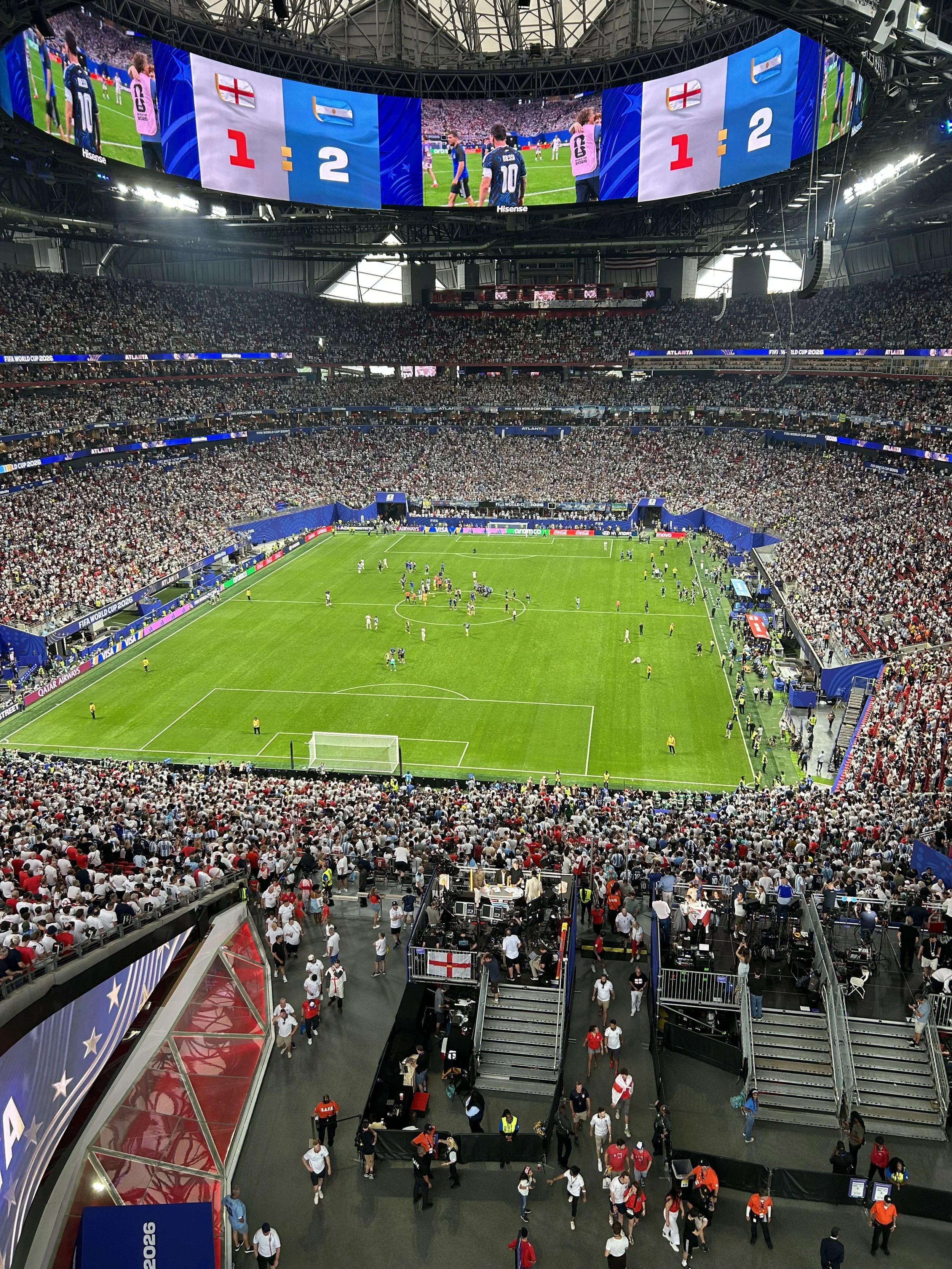
I was in the stadium when England scored. The noise was unreal. And then, slowly, you could feel something change. Not the scoreline. The intent. And that's what cost them.
I was there.
I was in the stadium when England scored. I heard what that sounds like when you're inside it. And I watched what happened next, which wasn't a tactical collapse or a defensive error or a moment of individual brilliance from Argentina — at least not at first.
What happened next was a shift in intent.
England went 1-0 up and seemed to make a decision without making a decision. Not out loud, not officially, not in any way that got communicated clearly on the pitch. Just that quiet drift that happens when a team stops asking "how do we win this?" and starts asking "how do we not lose it?" And if you've ever watched enough football, you know exactly what that looks like, because it doesn't look like anything. That's the problem. It looks like… nothing. Less urgency. Less press. Less of everything that got you the goal in the first place.
They lost 2-1.
And now the coach and the team are being criticized for a lack of intent after going ahead, which is fair. But what I want to do is take that conversation off the international stage and bring it somewhere that matters more to me — to every coach who's got a session tonight, a game this weekend, a group of players who are going to take their cues entirely from what you bring into the space.
Because intent is a coaching problem before it's a player problem. Always.
Why Are We Here?
Start with this question, and I mean really start with it — not as a formality, but as something you can actually answer at any moment.
Why are you here? Why is this session happening? What is the purpose of this group being on this field tonight?
If your answer is "to train" or "to work on pressing" or "to get ready for Saturday," that's not an answer. That's a schedule. Intent goes deeper. Intent is the reason behind the plan.
England's intent at 1-0 should have been: we are here to win a World Cup knockout game, we have shown we can hurt this team, and we are going to keep doing exactly that until the final whistle. That intent had a shape. A direction. Something to build on. Instead, the intent seemed to become: protect what we have and survive.
In grassroots coaching, the question looks different, but it's the same question. Why are you here? Is it because you believe this group of players can do something remarkable together, and every session is a step toward that? Is it because you want to give these kids the best experience of the game they're ever going to have? Is it because you're building something week by week that you can see clearly even when they can't yet?
Whatever it is — know it. Have it. Bring it.
Who Are the Players in Front of You?
Intent isn't generic. It's shaped by context, and context starts with your players.
The background your players carry into training matters. The player who had a difficult week at school. The one who's been dropped to the B team and hasn't dealt with it yet. The one who's been injured and is nervous about being back. The one who's been on a streak of great performances and is starting to get a bit comfortable. These are not distractions from coaching — they are the coaching.
England's players went into that game with context. Some of them have been chasing a tournament win their whole careers. Some of them have experienced heartbreak at this level before. That context either fuels intent or it works against it, and the job of the coaching staff is to know which one it is for each player in that dressing room.
At your level, the same principle applies. You can't build shared intent without understanding individual motivation. And you can't build individual motivation without knowing the person, not just the player.
The Game Model: Something to Believe In
The game model is often talked about in tactical terms — how we press, how we build, how we defend — but it's actually an intent document.
A game model tells your players: this is who we are. This is how we play. This is what we do when we have the ball, when we don't have it, when we win it back, when we lose it. This is us.
The problem with England sitting back at 1-0 wasn't just tactical. It was a contradiction of identity. This team, at its best, plays on the front foot. That's the model. That's who they are when they're good. So when they abandoned it the moment they had something to protect, they didn't just change shape — they lost themselves.
When your players know who they are and what your team is about, intent becomes self-correcting. A player who understands the model doesn't need to be told to press again after winning the ball — they do it because it's what they do. That's only possible when the model is genuinely believed in, not just followed.
Weekly Objectives: Intent Has to Be Current
A game model is the long view. The weekly objective is the near one. And both have to be alive at the same time.
This week, we're working on staying compact in transition. That's the objective. Now connect it back to the model, back to the purpose, back to why this group is on this field together. The weekly objective should never feel like a separate thing — it should feel like this week's version of the always-thing.
If your players finish a session and they can tell you what they worked on but not why it matters, the intent hasn't landed. The plan was communicated. The intent wasn't.
Communication: Sharing the Intent
This is where a lot of coaches get it almost right and then stop short.
You can have a clear game model, strong weekly objectives, and a genuine understanding of your players — and then walk into a session and describe what's happening without ever saying why it matters. You explain the drill. You explain the rules. You explain where the cones go. And your players go through it, and some of them get it and some of them don't, and you assume the ones who didn't get it just weren't paying attention.
But here's what's more likely: they didn't get the intent. They got the activity.
Communicating intent means connecting the thing you're doing right now to something bigger than the thing you're doing right now. "We're going to do this because in the game on Saturday, this is the moment we've been losing — and tonight we're going to change that." Or: "This is what our team looks like when we're at our best. Let's see if we can find that tonight."
That's a different entry point than "right, four corners, two teams, first to ten goals." Even if the session that follows is identical.
The Real Skill: Getting Them to Believe
Here's where I think coaching actually lives. Not in the plan. Not in the session design. Not in the tactics board or the cones or the formation.
It's in the transfer.
The real skill is taking the intent that you have — the clear why, the knowledge of your players, the game model, the weekly objective, the communication — and making it something your players genuinely feel. Not follow. Feel.
Because a player who's following intent will sit back when the team goes 1-0 up. A player who believes in intent doesn't know how to do that. It's not in them. Their body doesn't know how to play without urgency once it's understood why the urgency matters.
That transfer happens through relationship. Through consistency. Through being the kind of coach whose purpose is visible not just at the start of the season but at 1-0 up with twenty minutes to go in a knockout game.
England's players are not short of quality. They're not short of experience. What was missing in those twenty minutes was belief — belief that the intent that got them the goal was still the right response to the situation, even when every instinct was telling them to pull the shutters down.
Building that belief is the job. In every session, at every age, with every group.
Not just when the season starts.
Not just when things are going well.
At 1-0 up, with the crowd noise fading, and the other team starting to come.
That's when intent matters most.
@LeeDunneSoccer
BREAK — Breaking Lines and Beating Pressure.
BREAK is the most exciting word in the Common Language — and it's where everything else pays off. SCAN, SHAPE, SUPPORT, BUILD — they all lead here. Learn what BREAK looks like at every age group and how players can start recognizing and taking those moments with confidence.
One word in the Common Language. Start with the full methodology.
Ronaldo. R9. The OG.
"He gets the ball, and he goes to goal."
That's it. That's BREAK.
It's the most exciting word in our Common Language and probably the one players respond to most instinctively. Because BREAK is the moment we all live for. The space opens up, the defense isn't ready, and we go.
But here's what most people miss: BREAK is not a random burst. It's calculated. It's aggressive and devastating — yes — but it's intelligent.
When I shout "BREAK" from the sideline, I'm saying: the moment is here. Go. Now. Don't hesitate.
Because hesitation kills the break. The window closes. The defender recovers. The moment is gone.
At 7v7, there's space everywhere. Kids this age have an almost natural instinct to BREAK — they see the goal and they go. The work at this level is channeling that instinct into something productive, so it becomes habit rather than chaos.
At 9v9, the game tightens. There are more players, more defenders, and the goalkeeper is bigger. BREAK moments still happen, but they require more reading — recognizing that the opponent is high, that there's space in behind, that a first touch can take you into space instead of back into pressure.
At 11v11, breakaways to goal are rarer. But BREAK as a concept is everywhere — breaking pressure in your own half, breaking across halfway with a big touch, breaking through the lines with a combination, breaking out wide after winning the ball in the middle. BREAK isn't only about scoring. It's about taking advantage of any moment the opponent isn't organized.
The key to a great BREAK is one thing: changing pace. Slow to fast. That's how you beat a defender. That's how you make a goalkeeper uncertain. You lull them into thinking you're just building — and then you go.
I love asking families this question: how many times could your child have broken in that game? Did they? If not — why not?
Because sometimes players scan well, they're in great shape, they've supported, they've helped build — and then the moment to BREAK comes and they don't take it. They pass back. They slow down. They second-guess.
Confidence is part of BREAK. Trust is part of it. Knowing you've earned the right to go — because the work before the break was done — that's what makes it work.
SCAN. See the moment before it comes.
SHAPE. Be in the right place for it.
SUPPORT. Make sure your teammates are with you.
BUILD. Keep the ball until the moment opens.
BREAK. And when it does — go.
Five words. One framework. Connecting training to the game, every week.
@LeeDunneSoccer
BUILD — Playing Out and Moving the Ball Forward.
BUILD is the coaching word for keeping the ball with purpose. From Xavi's philosophy to 7v7 goal kicks, this word teaches players of all ages to resist the kick-and-rush instinct and find the better option. Here's how it works at every level.
One word in the Common Language. Start with the full methodology.
Xavi's quote is one of the best in the game: "Do something with the ball other than kick it out."
Simple. Direct. And the reason Barcelona dominated world football for a decade.
BUILD is the word I use when I want the team to keep the ball with purpose. To move it. To find the teammate. To resist the instinct to just hoof it forward and hope.
It sounds easy. It isn't. And it's one of the most important habits in the game to develop from a young age.
When I shout "BUILD" from the sideline, I'm saying: don't panic. We have the ball. Find the space. Find the teammate. Work it forward the right way.
BUILD isn't just about goal kicks — though that's where most coaches introduce it. BUILD is about recycling possession every time we can't go forward. It's about moving the opponent by making them chase the ball. It's about creating those moments where we can BREAK.
In fact, BUILD and BREAK are deeply connected. The best teams in the world BUILD until the moment opens up, and then they BREAK. They're patient. They're purposeful. They wear the opponent down and then exploit the space.
At 7v7, BUILD is foundational. For young players, the instinct is to kick it long — to clear the danger, to find the striker, to get it away from goal. That's natural. But we use the build-out line to encourage them to think differently. Can we play out from the back? Can we find someone in a better position? Can we keep it rather than give it away?
At 9v9, BUILD becomes more sophisticated. The field is bigger, there are more players, and the patterns start to develop. Building from goal kicks with a structure. Identifying pressure and playing around it. Using the third-man combination to escape a press.
At 11v11, BUILD is a style of play. It's an identity. Teams that can build — that can keep the ball, move the opponent, and create chances through patience — win games they shouldn't. They control the game even when the other team has better individual players.
If your child panics with the ball, BUILD is the word to focus on. Panic comes from not knowing what to do next. And BUILD gives them a default — when in doubt, find someone in a better position. Keep it. Move it. Don't give it away.
The goal isn't to be possession-obsessed. The goal is to be purposeful. We don't build for the sake of it — we build to create moments. To move the opponent. To find the weak spot. And when we see it — we BREAK.
That's next.
@LeeDunneSoccer
SUPPORT — Giving the Ball Carrier an Option.
SUPPORT is the word that covers everything — from tactical positioning to team culture. Pelé said no individual wins the game alone, and this word is why. Here's what it means at every age group and why it matters on and off the field.
One word in the Common Language. Start with the full methodology.
Pelé said it: "No individual can win the game by themselves."
He's the greatest of all time, and that's what he leads with. Not goals. Not skill. Not speed. Support.
SUPPORT is probably the word in our Common Language with the most emotional weight to it. Because support isn't just a tactical concept. It's a cultural one.
When I shout "SUPPORT" from the sideline, I might mean: get closer to the player on the ball so they have a passing option. I might mean: track that run — your teammate is exposed. I might mean: move into that space behind the defensive line. Or I might just mean: get in a position to help.
But off the field, SUPPORT means something different. It means cheering for a teammate who just made a mistake. It means not throwing your hands up when someone misses a chance. It means being the first one over when a teammate goes down.
Both kinds of support matter. And neither is possible without the other.
On the field, SUPPORT is about ball movement and player movement. Every player in possession should have at least two supporting options at all times. SUPPORT breaks the habit of "bunch ball" — that beautiful chaos where 12 players are chasing one ball and nobody is in position.
At 7v7, the job is simple: can we get two or three players offering options? Can we break the bunch ball just a little? Small steps, big payoff.
At 9v9, support starts to look like connecting the dots. Players are learning to see the picture — where should I be to help my teammate on the ball? How do I create an overload? How do I give them an option to break pressure?
At 11v11, SUPPORT is everything. Keeping space from the player on the ball. Positioning between the lines for those killer passes defenders can't reach. Double-team defending. Covering rotation. Constant movement to create numerical advantages in both phases of the game.
Here's what I love about SUPPORT as a Common Language word: it applies everywhere, at every moment.
We just won the ball? SUPPORT the counter. We just lost it? SUPPORT the press. The goalkeeper has it? SUPPORT the build-up. A teammate is being pressured? SUPPORT by giving them an out.
One word. Every moment.
And the challenge I give families: does your kid support on and off the field? Because the ones who cheer for their teammates, who communicate, who show up ready to help — they're easier to coach, easier to play with, and they make the whole team better regardless of what they do with the ball.
SUPPORT is teamwork. It's cohesion. It's control.
And it's the word that turns a group of players into a team.
@LeeDunneSoccer
SHAPE — More Than Formation. Positional Relationships. Movement. Fluidity.
SHAPE is more than a formation — it's a live, dynamic concept that changes with every moment of the game. One word covers everything from defensive positioning to attacking overloads. Here's what it means at every age group.
One word in the Common Language. Start with the full methodology.
If SCAN is about seeing the game, SHAPE is about being in the right place for it.
Pep Guardiola's teams are the best example of shape done right. His quote says everything: "The objective is to give nothing to the opponent." When your team has great shape, the opponent doesn't know where to go. There's no space to exploit, no gaps to run into. The ball goes backwards because there's nowhere to go forward.
That's what SHAPE does.
But here's the most important thing I want you to take away: SHAPE is not a formation. A formation is a starting point on a piece of paper. SHAPE is what happens live, during the game, in real time.
Shape is the entire team and their positions relative to the ball. It's about overloads around the ball — those moments where we have more players than they do in a tight area. It's about the opportunities that exist away from the ball. And it's about every single player knowing where they should be in both defense and attack.
When I shout "SHAPE" from the sideline, I could mean a dozen different things.
I might mean a player is out of position and needs to come back. I might mean we just lost the ball and the whole team needs to shift defensively — right now. I might mean we need a big attacking shape to control the game. I might mean a player needs to anticipate where to move before the demand appears.
One word. A dozen meanings. That's the power of a common language.
At 7v7, shape is mostly about formation awareness — where do I stand for a goal kick? What are my starting positions for set pieces? Where do I move when we don't have the ball? Younger players are naturally drawn to the ball, and that's fine. But introducing SHAPE starts to build the habit of finding your position rather than chasing the play.
At 9v9, it gets richer. Players are starting to understand position rotation — when someone pushes forward, someone covers. They're beginning to recognize marking assignments and understand what defensive compactness actually feels like in a game.
At 11v11, shape is everything. Movement to create overloads, positioning between the lines for killer passes, anticipating pending demands — all of it happening simultaneously. A team with great shape feels organized, connected, and genuinely hard to break down.
Here's a question for the car ride home: "Were you in the right shape when we didn't have the ball?"
It sounds simple. It isn't.
Because maintaining your shape when you don't have the ball — when your instinct is to watch, or to drift — that's where games are won and lost.
SHAPE is control. It's understanding. It's recognition.
When the whole team has it, you give the opponent nothing.
@LeeDunneSoccer
SCAN — Teaching Players to Look Before They Receive.
The best players on your team aren't faster than everyone else. They just already know what's around them before the ball gets there.
One word in the Common Language. Start with the full methodology.
The first word in our Common Language is SCAN. And it's arguably the most important one.
Here's the thing about SCAN — it's not just a coaching instruction. It's a way of playing the game. It's the difference between a player who reacts to what just happened and a player who's already prepared for what's coming next.
Declan Rice said it best: "If you're not scanning, you've got no chance."
He's right.
When I shout "SCAN" from the sideline, I'm not just asking a player to turn their head. Well, I am — but I'm really asking for something bigger. I'm asking them to gather information. To see the space. To find the open teammate. To notice where the opponent is and where they're not. To ask themselves: where could I be in trouble, and where is the opportunity?
At the youngest levels — 7v7 — my first job with SCAN is simply to get players to lift their heads. At this age, the ball is the universe. Everything is about chasing it, winning it, and scoring with it. That's natural. That's beautiful, even. But if we can start to ask them to see what's around them, something shifts.
By 9v9, the game starts to slow down in their minds — not because it's physically slower, but because they're starting to anticipate. They're not just reacting to what just happened. They're beginning to predict what might happen next.
At 11v11, the best players aren't playing the game in front of them. They're two or three moments ahead. They know where they're passing before the ball arrives. They know which teammate is open, which zone to move into, and whether there's a BREAK moment developing on the other side of the field.
That's SCAN.
When a player is scanning well, you'll notice their body position opens up. They're not square to the ball — they're angled, so they can receive and immediately see more of the field. They're preparing for the second ball. They're moving into supportive positions before they're even needed.
The question I ask families — and it's one you can use in the car on the way home from a game — is simple: "Did you see what was happening around you before you got the ball?"
Not "did you score?" Not "did you have a good game?"
Did you scan?
Because if a player is scanning consistently, the good moments will come. The goals, the assists, the great decisions — all of it follows when a player is genuinely reading the game.
When they scan, they anticipate and prepare. Their body position opens up, which creates more opportunity. Their confidence goes up because they're no longer surprised by the game — they saw it coming.
This isn't about telling your kid to "look around more." It's about building a habit. Every time they receive the ball, they've already done the work. They know what's coming. They're ready.
SCAN is the foundation. And it's the first of five words that connect what happens in training to what happens on match day.
Next up — SHAPE.
@LeeDunneSoccer
The Power of a Common Language
One word said the same way, every session, every game. The language is simple for players — but behind each word is a deep, complex framework that takes years to build. Here's why a common language might be the most powerful coaching tool you're not using.
I've been coaching for a long time. And one of the things I keep coming back to — the thing that has changed how I coach more than any course, any badge, or any system — is the idea of a common language.
One word. Said the same way, every session, every game. And over time, that word carries an entire world of meaning.
Let me explain what I mean.
When I say "SCAN" from the sideline, my player hears one thing: look around, see what's happening, get ready. Simple. Clear. Instant.
What they don't see is the hours of thinking behind that word. The developmental psychology of how young players process information. The body positioning science that tells us an open stance increases the quality of a first touch. The tactical understanding of what it means to read a game two moments ahead. The relationship between scanning frequency and decision-making speed at the elite level.
They don't see any of that. They hear SCAN. They scan. The game slows down.
That's the power of a common language.
There's a phrase I keep coming back to: simplistic in delivery, complex in meaning. And that's the whole idea. The word is for the player. The complexity is for me as the coach. My job is to do the deep work — to understand the why, to build it into sessions week after week, to create the conditions where the word lands at exactly the right moment. The player's job is to hear it and respond.
Too many coaches do the opposite. They over-explain. They use tactical language that even adults find confusing. They say "maintain your defensive shape while transitioning into a mid-block" and then wonder why a twelve-year-old looks at them blankly.
Players don't need complexity. Players need clarity.
What they need is a word they know. A word they've practiced. A word that connects what they did in training on Tuesday to what's happening on the field right now on Saturday morning. That's the bridge. That's what a common language builds.
And here's something I didn't fully appreciate until I started working with larger groups of coaches: a common language doesn't just help players. It aligns an entire coaching staff. When every coach in your program uses the same five words, something remarkable happens. A player can move from a U8 session to a U12 session and hear the same instruction. They carry that word with them as they grow. By the time they're playing 11v11, SHAPE means something rich and deep — because they've been hearing it and practicing it since they were seven years old.
That's not just coaching. That's development.
The five words I've built our language around are SCAN, SHAPE, SUPPORT, BUILD, and BREAK. Each one is a concept. Each one applies to every age group, every formation, every moment of the game — but in different ways, at different levels of sophistication. What BREAK means for a 7-year-old is different from what it means for a 15-year-old. But the word is the same. The habit is the same. The connection between coach and player is the same.
And that's the point.
Over the next five blogs I'll break down each word — what it means, why I chose it, how I teach it across age groups, and what families can listen for on the sideline and talk about on the way home.
Because common language doesn't stop at the touchline. When a parent knows the word, and asks about it in the car, and the player explains what happened in the game — that's the real learning. That's when it sticks.
The Five Words
Work through them in order. Each one builds on the last.
- SCAN — teaching players to look before they receive
- SHAPE — body position before the ball arrives
- SUPPORT — giving the ball carrier an option
- BUILD — playing out and moving the ball forward
- BREAK — breaking lines and beating pressure
Go Further
- How the language shows up in a session — the game is already in your practice.
- Keeping it consistent across a whole club — for DOCs and anyone running a staff.
- Download the Common Language resource — the tools, ready to use.
@LeeDunneSoccer
The World Cup Is a Free Coaching Resource. Are You Using It?
"Every four years, the whole world starts paying attention to soccer. Registration goes up. Kids are playing it on the street. They're playing FIFA. They actually want to talk about the game. This is a freebie. Don't waste it."
Every four years something happens that we spend the rest of the time trying to manufacture.
Players show up to training talking about the game. They're watching matches. They're arguing about players. Their parents are asking questions. Families who've never cared about soccer are suddenly watching it together. Registration interest goes up. Kids are out in the street playing it.
The World Cup does in four weeks what the average youth soccer club tries to do all year. And it does it for free.
The question is how you use it.
The First Half Challenge
The first thing I do with my players during a major tournament is give them one task per game: watch the first half.
Not the whole game. Just the first half. And not as homework — as an investigation.
Here's why the first half: both teams are still playing to their plan. By the second half, substitutions have happened, the scoreline is influencing decisions, teams are reacting to each other. What you see in the second half is a lot messier and harder to learn from. The first half is where you see the game models in action, where players are executing what they've been trained to do.
Within that first half, I ask my players to watch the player at their position. Not the stars — the player doing their job. What did they do well? What did they struggle with? What was the game asking of them that they either handled or didn't?
Then I ask the connection question: your team asks similar things of you in that position. How do those expectations compare to what you just watched?
That question alone can generate more real coaching conversation than three sessions of drills.
Don't Make It Feel Like a Job
Here's what I'm always careful about: I don't want players watching the World Cup and feeling like it's work.
The best way to kill a kid's relationship with the game is to turn every moment of joy into an assessment. If they're watching the US play and every time something happens they have to fill in a form, you've ruined it. That's not how fans fall in love with the sport, and the long-term value of a player who loves the game is greater than any specific tactical insight you might extract from one tournament game.
So alongside the position challenge, I also ask them something much simpler: what was the best moment of the game?
Not the most tactically interesting. Not the most instructive. The best. The thing that made them shout, or laugh, or rewind it twice, or send it to a teammate. That question reconnects them with why any of us watch in the first place.
Bring the Families In
This is where the real opportunity sits, and most coaches don't go near it.
Your players are 12 to 18 people. Those players have families. Those families have neighbors. One World Cup can touch more people in your community than a full season of league games, if you give it a little structure.
A bracket. Nothing complicated — who's going to win each group, who's going to the final, who's going to win it. Get your players to fill one in and send it to the group chat. Then ask them to do one with a parent, or a sibling, or whoever's at home.
Now soccer is happening at the dinner table. Parents who've never watched a match are suddenly invested in Croatia's result because their kid picked them to get to the final. That's culture. That's the game growing in a family. And families that are invested in the game support youth soccer differently than families who see it as just a Saturday morning obligation.
Predict the first scoreline. Pick the player who'll have the biggest impact in each game. Ask your players to send you their predictions before kickoff. You'll learn something about how they see the game, and they'll feel like someone in coaching actually cares what they think.
The Cyclical Opportunity
Here's the thing about the World Cup that's easy to miss when you're caught up in the day-to-day of running a club or coaching a team: it's cyclical. Every four years, the game comes to the world's attention in a way nothing else achieves. And every four years, clubs and coaches either use that moment or let it pass.
The clubs that use it see bumps in registration. They see players arriving to training with questions. They see parents at the sideline who are suddenly curious about positions and tactics. They see players who've watched their positional counterpart play on the world stage and want to understand what they saw.
That window is open right now. Your players are watching. They're paying attention. The game has their interest in a way it might not have for another four years.
Ask them what they're seeing. Challenge them to watch one half properly. Let them make the predictions. Bring their families into it.
The World Cup is doing the hard work. Your job is to make the connection.
Listen to the full episode: Ep. 73 — The World Cup Is Coming (2022)
@LeeDunneSoccer